Data Can Save Lives: The KPIs Jamaica Should Be Tracking After Hurricane Melissa
Picture this: It's 3 AM, twelve hours after Hurricane Melissa made landfall. In a dimly lit emergency command centre powered by a generator, Sarah Campbell, Jamaica's Director of Emergency Management, stares at a wall of blank screens. Her phone buzzes incessantly with fragmented reports: "Road blocked in Manchester," "Shelter flooded in Clarendon," "Can't reach St. Elizabeth."
This is the nightmare scenario every disaster manager fears, flying blind when every decision could mean life or death. But what if those screens weren't blank? What if, instead, they showed real-time data streams painting a clear picture of who needs help, where, and how urgently?
The difference between chaos and coordination, between panic and progress, often comes down to one thing: the right data, tracked in real time, driving every critical decision.
The Anatomy of Disaster: When Every Second Counts
Data is more than just numbers in a spreadsheet; its families waiting on rooftops, hospitals running on fumes, and communities cut off from the world. After working in risk management for over a decade, I've learned that disasters reveal the brutal truth: countries that measure well, recover well. Those who don't often spiral into prolonged suffering.
Let me tell you about the 10+ KPIs data that can transform Jamaica from a hurricane victim into a master of recovery. These aren't abstract metrics; they're lifelines with stories behind every percentage point.
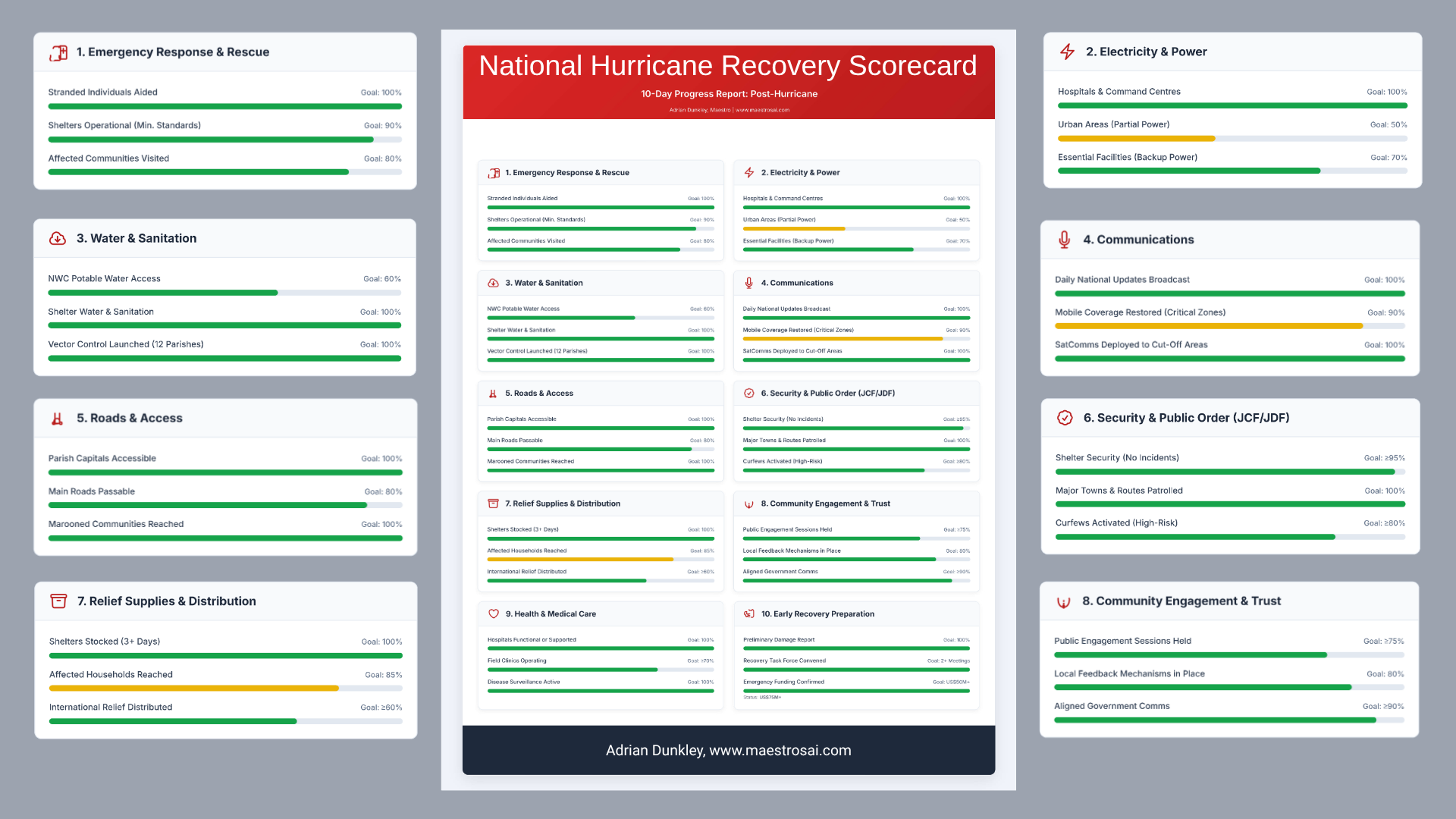
Hurricane Melissa Recovery Scorecard
1. Emergency Response: The Race Against Time
Imagine Maria, a grandmother trapped in her flooding house in Spanish Town. She calls the emergency line at 2 PM. In a data-driven response system, Maria becomes more than just another voice crying for help; she becomes a trackable rescue mission with a timer running.
The brutal truth: Every stranded person should appear as a number on a dashboard until they're safe. Why? Because invisible people die forgotten. In disasters, if you're not counted, you don't count.
Critical Metrics:
One hundred per cent of reported stranded individuals must be located or reached because ninety-nine per cent means someone dies waiting.
Ninety percent of emergency shelters must meet safety standards because unsafe shelter is often worse than no shelter.
Eighty percent of affected communities must be visited by first responders because isolation breeds panic and despair.
When rescue teams know exactly where Maria is, how long she's been waiting, and what resources she needs, they can save her life efficiently. Without this data, they're just driving around hoping to find people before it's too late.
2. Power: The Invisible Foundation
Dr. Michael Brown arrives at Kingston Public Hospital to find the emergency room in darkness. The backup generator failed, the operating theater is shutting down, and patients on life support are being manually ventilated. This scene has played out in disasters worldwide,but it doesn't have to.
Here's what most people don't understand: Power isn't about convenience,it's about whether people live or die. No power means no water pumps, no communication, no refrigerated medicine, no life support. Every percentage point of power restoration equals lives saved.
Essential Tracking:
One hundred percent of hospitals and command centers must be powered by grid or generator because when these fail, the death toll multiplies.
Fifty percent of urban households need partial electricity because this critical mass enables community recovery.
Seventy percent of essential facilities require backup power because planning for failure prevents catastrophic collapse.
3. Water: The Silent Killer
Three days after Hurricane Melissa, ten,year,old Jason starts showing symptoms of severe dehydration. His family in Portmore has been drinking from a contaminated well because the water trucks haven't reached their neighborhood yet. Jason's story could have been prevented with better water tracking,and it illustrates why clean water data is literally a matter of life and death.
The shocking reality: More people die from contaminated water after disasters than from the initial storm. Cholera, dysentery, and dehydration spread faster than rescue teams can move,unless you're tracking water access in real,time.
Life-Saving Metrics:
Sixty percent of the population must have access to safe water as the minimum threshold to prevent widespread disease outbreak.
One hundred percent of shelters must receive daily water deliveries because crowded, unsanitary conditions create perfect disease incubators.
Vector control must reach eighty thousand or more households because stagnant water breeds mosquitoes, and mosquitoes breed disease.
4. Communication: The Trust Lifeline
"The government has abandoned us," Patricia Williams tells her neighbor as they sit in darkness in rural St. Catherine. She hasn't heard any official updates in two days. Meanwhile, just fifteen miles away in Spanish Town, relief supplies are being distributed and roads are being cleared. Patricia isn't abandoned,she's uninformed. And in disasters, uninformed populations make dangerous decisions.
Communication isn't just about keeping people informed,it's about keeping them alive and hopeful. When people lose trust in authorities, they stop following safety protocols, they hoard resources, and they make desperate choices that endanger everyone.
Trust-Building Metrics:
Daily updates must flow across four major channels because redundancy saves lives when people are scared.
Ninety percent mobile coverage restoration in populated areas because connection equals hope.
Satellite communication must reach all cut off areas because no community should face disaster alone.
5. Access: The Geography of Desperation
The residents of Rock River, a small mountain community, watch as helicopters fly overhead for three days straight. They're waving sheets, shouting, but no one stops. Unknown to them, their village doesn't appear on the primary relief maps, and the one access road is blocked by a massive landslide that hasn't been reported to central command.
Here's the brutal equation: No road access = no relief = no survival. Physical isolation isn't just an inconvenience,it's a death sentence. Communities that can't be reached quickly become communities that are forgotten.
Critical Access Metrics:
Every parish capital must remain accessible by at least one passable route.
Eighty percent of main roads must be cleared for relief transport.
All isolated communities must be reached within ten days because after that, people start dying.
The Ripple Effect: How Data Creates Hope
Let me paint you a different picture. It's 3 AM, twelve hours after Hurricane Melissa. Sarah Campbell is still in the emergency center, but now the screens glow with real,time data streams. She can see that 847 people are in emergency shelters (all with adequate water and power). She knows that 23 individuals are still awaiting rescue (with precise GPS coordinates and estimated arrival times for each). She sees that 67% of critical infrastructure is operational.
More importantly, she can tell Maria's family exactly when help is coming. She can reassure Dr. Brown that backup power is en route to his hospital. She can dispatch water trucks to Jason's neighborhood before disease takes hold. She can send a helicopter to Rock River because they're visible on her dashboard.
This isn't science fiction but the power of systematic data collection in action.
Jamaica has something many disaster prone nations lack: the infrastructure, education system, and technological capacity to implement world class disaster data systems. With the right commitment to measurement and transparency, Jamaica could become the Caribbean's model for disaster resilience not because it has the most money, but because it has the most discipline in data collection.
The Complete Arsenal
Beyond the five categories above, comprehensive disaster response requires tracking:
Security and Order: Ninety five percent of shelters must report zero major incidents, because disaster survivors deserve safety and dignity.
Relief Distribution: Every relief item must be trackable from arrival to family hands because in disasters, corruption kills.
Community Engagement: Seventy five percent of parishes must hold public meetings because people need voice, not just aid.
Health Services: All hospitals must remain operational with disease surveillance active because epidemics start small and spread fast.
Early Recovery: Damage assessments must be published and recovery funding secured because hope requires a visible future.
Governance and Inclusion: All data must be disaggregated by gender, age, and disability because invisible populations suffer most.
Jamaica has something many disaster prone nations lack: the infrastructure, education system, and technological capacity to implement world class disaster data systems. With the right commitment to measurement and transparency, Jamaica could become the Caribbean's model for disaster resilience not because it has the most money, but because it has the most discipline in data collection.
The choice is clear: Jamaica can continue reacting to disasters with good intentions and fragmented information, or it can lead with data, transparency, and systematic accountability. The next hurricane is coming and the question is whether Jamaica will be ready to count what matters.
Data is how we lead in the dark. And in the Caribbean, we need more leaders willing to turn on the lights.
About the Author
Adrian Dunkley is the Caribbean’s leading expert in Artificial Intelligence, and the Founder and CEO of StarApple AI, the first Caribbean AI company.
With over 15 years of experience in Artificial Intelligence and a decade in Risk Management, he has built hundreds of AI products across finance, insurance, tourism, medicine, and sports, transforming how industries across the region use data and automation. Adrian has also trained hundreds of professionals in AI development, creating a new wave of regional innovators ready for the digital economy.
An award-winning entrepreneur and innovator, Adrian serves on multiple boards and is the co-founder of several AI and technology startups driving growth throughout the Caribbean.
He is also a philanthropist, donating millions toward education, technology access, and youth development. In addition, he serves as the principal of 14 West, a US $1 million AI investment fund dedicated to accelerating the growth of Caribbean AI ventures.
Through StarApple AI, Adrian’s mission is to bridge island creativity with global innovation, empowering Caribbean nations to lead confidently in the era of intelligent technology.