Science Communication with A.I
Invasion of the Atlantic Ocean and Caribbean Sea by a Large Benthic Foraminifer in the Little Ice Age.
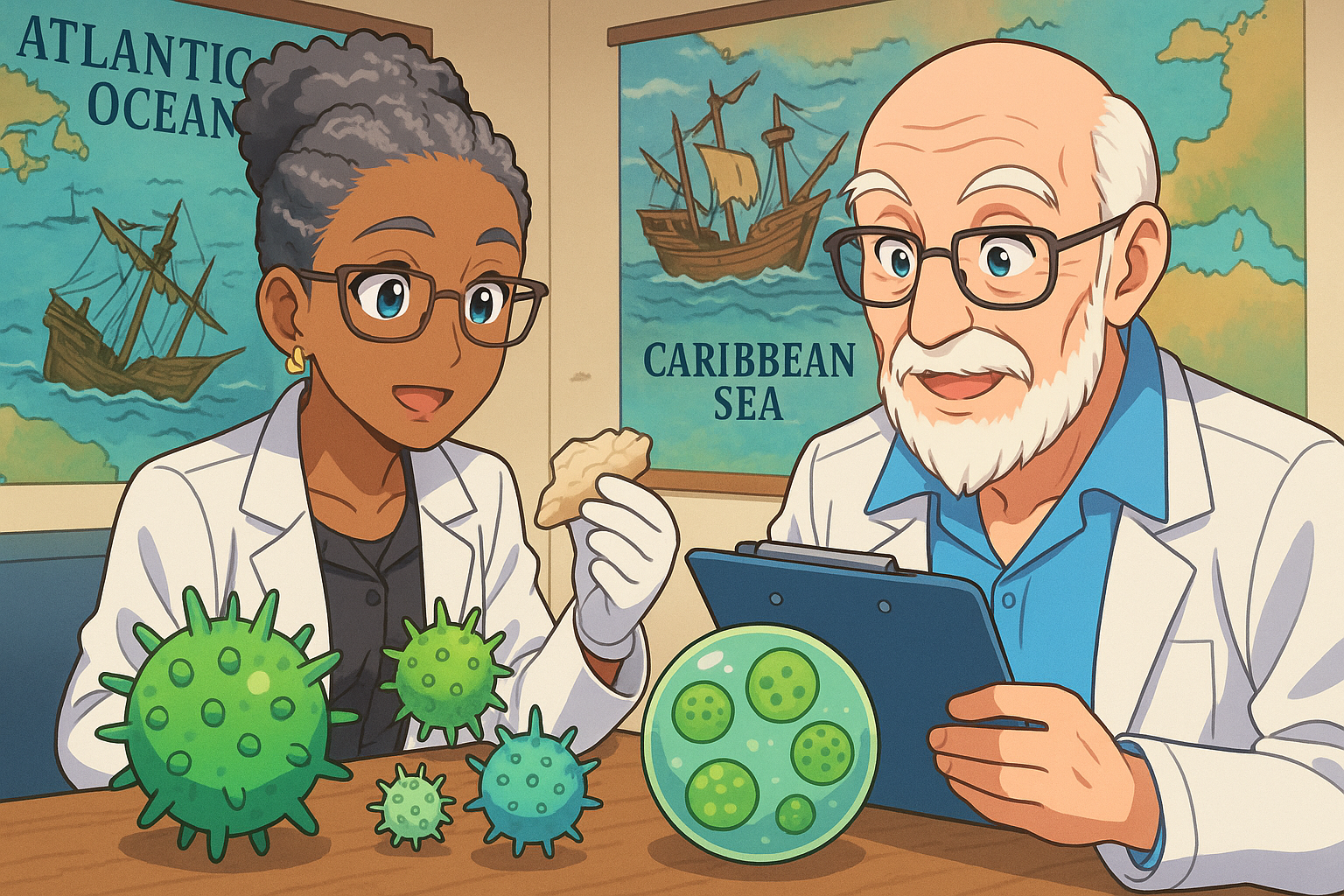
Prof Edward Robinson and Dr Thera Edwards
Department of Geography & Geology, The University of the West Indies, Mona Campus, Kgn 7,JA
Hi, welcome to the Science Comm page for Prof Edward Robinson and Dr Thera Edwards’ paper: Robinson, E.; Edwards, T. Invasion of the Atlantic Ocean and Caribbean Sea by a Large Benthic Foraminifer in the Little Ice Age. Diversity 2025, 17, 110. https:// doi.org/10.3390/d17020110
This Page contains the following:
Explainer Video
Podcast discussing the paper
A Non-technical explainer
FAQs
Enjoy Science!
The paper examines the constraints and vectors that allowed the Large Benthic Foraminifer (LBF) Heterostegina depressa to invade the Atlantic and Caribbean Region (ACR) from the Indo-Pacific Region (IPR). The authors hypothesize that natural dispersal mechanisms were unlikely due to physical impediments like cold Sea Surface Temperatures (SSTs) and thus concluded that anthropogenic vectors, specifically sailing ships using hull fouling or solid ballast, accomplished the invasion during the Little Ice Age (1350–1850 C.E.). The introduction likely occurred shortly after 1497, when Portuguese trade opened new shipping routes, providing a model with specific temporal parameters that can be tested using methods such as isotopic dating of foraminiferal assemblages or genetic similarity studies
Listen to the Podcast
°🌊⋆⚓🫧
Listen to the Podcast °🌊⋆⚓🫧
The Explainer
How a Microscopic Stowaway on a 15th-Century Ship Solved a 3-Million-Year-Old Ocean Mystery
A 3-Million-Year-Old Wall
It’s a fundamental question of natural history: how can two oceans, separated by an entire continent, share similar forms of life? For the last three million years, a massive geological barrier has made this question particularly puzzling for the Atlantic and Pacific oceans. The formation of the Isthmus of Panama created an impenetrable wall, isolating the warm, tropical waters of the Atlantic Ocean and the Caribbean Sea from the vast Indo-Pacific.
This separation created two distinct marine worlds. Yet, scientists discovered a biogeographic mystery that challenged this separation: the presence of Heterostegina depressa, a tiny marine organism native to the Indo-Pacific, thriving in the isolated Atlantic. With no natural way to cross the land bridge, how did this microscopic invader make an impossible journey? New research reveals an answer that rewrites the history of human impact on the planet, pointing not to modern supertankers, but to the wooden sailing ships of 15th-century explorers.
The Surprising Takeaways from a Microscopic Stowaway
1. We've Underestimated How Long Humans Have Been Moving Species Across Oceans
When we think of invasive species crossing oceans, we typically picture modern problems—the ballast water of enormous commercial ships or creatures clinging to massive steel hulls. This involuntary transport is seen as a recent phenomenon, a consequence of our industrial age.
However, the research on H. depressa counters this assumption entirely. The findings show that this process began much earlier, during the age of exploration. After systematically ruling out all natural possibilities, the study posits that the wooden sailing ships of the late 15th century were the "only likely means of transport" for this microscopic organism from its home in the Indo-Pacific to its new home in the Atlantic.
2. Nature's Superhighways Were Actually Dead Ends
Before concluding human involvement, researchers first had to rule out nature. Two plausible "natural" routes existed for an Indo-Pacific species to enter the Atlantic: a westward journey around the southern tip of South America or an eastward journey around South Africa.
But for a tropical, warmth-dependent organism like H. depressa, both of these routes were impossible.
Around South America: This was a non-starter. The sea surface temperatures at the continent's southern tip are a frigid 6–10 °C, far too cold for a tropical species to survive.
Around South Africa: This route presented a dual barrier. First, the water temperatures were marginally unfavorable. This route was already a challenge, but the invasion occurred during the "Little Ice Age" (1350–1850 C.E.), a period when global temperatures dropped, making these already cold waters an even more formidable barrier to a tropical organism. Second, even if a creature survived the cape, it would face a 2000 km stretch of cold coastal upwelling on the southwest African coast. Even warm water eddies known as Agulhas Rings, which spin off from the Indian Ocean, would have dissipated in waters far too cold for H. depressa to survive the journey into the warmer Atlantic.
The counter-intuitive conclusion was clear: all natural invasion routes were effectively blocked. With nature ruled out, the investigation turned to the ships themselves—and the perfectly adapted organism that was poised to take advantage of them.
3. A Perfectly Adapted Hitchhiker Met the Perfect Ride
The organism at the center of this story, Heterostegina depressa, is a type of "Larger Benthic Foraminifer" (LBF)—a single-celled, shell-building protist. This accidental pioneer was equipped with the perfect survivor's toolkit for a long, arduous ocean voyage.
It could endure weeks of darkness in a ship's hold, tolerate frigid temperatures far from its tropical home, and its young could lie dormant for up to two years, waiting for the right moment to establish a new colony. Because it lives in a wide range of water depths, including shallow intertidal zones, it could have easily become an unwitting passenger. The nooks and crannies of a wooden hull, scarred by boring species like Teredo shipworms, dry rot, and scrapes against coastal rocks, would have provided a perfect home. Alternatively, it could have been scooped up with the coastal sand and rock used for solid ballast.
The conclusion is inescapable: the researchers state that H. depressa could only have been introduced to the Atlantic as a stowaway—either clinging to the hulls of ships or mixed in with ballast material—on Portuguese voyages that began rounding Africa at the end of the 15th century.
4. The Invasion Has a Surprisingly Precise Timeline: 1497-1826
By combining biological evidence with historical records, researchers were able to pinpoint the invasion to a specific 330-year window.
The Start Point (1497): The starting gun for this invasion fired in 1497, when Vasco da Gama's fleet of caravels successfully rounded the Cape of Good Hope. For the first time, Portuguese trade voyages created a direct, human-made transport vector between the Indo-Pacific and the Atlantic. These were perilous journeys on an epic scale; on average, about one in four ships was lost on each Portuguese voyage.
The End Point (1826): The window closes with the formal scientific description of H. depressa from a sample found on St. Helena—the same remote island prison where Napoleon Bonaparte had died just five years earlier, a place that was, for centuries, one of the most vital and isolated shipping hubs in the world.
The location is a crucial clue. St. Helena was discovered by the Portuguese in 1502 and quickly became an essential stopover for repairing and resupplying ships on the return journey from the Indo-Pacific. This makes the island a plausible "ground zero" for the Atlantic invasion, a place where the microscopic hitchhikers could have first disembarked and established a new population.
Rethinking What It Means to Be "Native"
The incredible journey of a single-celled organism, transported across the globe by 15th-century explorers, fundamentally challenges our modern understanding of biogeography and human impact. It shows that globalization, at least on a microscopic scale, began centuries before we thought.
This isn't just the story of one organism. This model of historical, human-driven invasion could potentially be applied to dozens of other species. Researchers have noted that a staggering 53 of 878 species of modern foraminifera on the North and Central American Atlantic coasts also have no fossil record, suggesting they too may be recent arrivals. One such candidate, Borelis pulchra, shares a similar unexplained presence. The journey of H. depressa might just be the key to unlocking dozens of other biological cold cases.
This incredible journey makes you wonder: how many other species we consider 'native' are actually ancient castaways, their stories of arrival lost to the currents of history?
Frequently Asked Questions (FAQs) about the paper
This FAQ section summarizes the key findings of the paper "Invasion of the Atlantic Ocean and Caribbean Sea by a Large Benthic Foraminifer in the Little Ice Age" by Edward Robinson and Thera Edwards, published in Diversity.
Q1: What is the primary subject of this research?
The paper examines the constraints and vectors controlling the invasion of warm-water taxa, specifically the Large Benthic Foraminifer (LBF) Heterostegina depressa, from the Indo-Pacific Region (IPR) into the Atlantic and Caribbean Region (ACR). The authors hypothesize that this invasion occurred during the Little Ice Age (1350–1850 C.E.) and was facilitated by human activity.
Q2: What is a Large Benthic Foraminifer (LBF)?
LBFs are an informal group of marine protists (single-celled organisms) that possess shells and harbor symbiotic algae. They are geographically confined to shallow tropical and subtropical waters, often associated with coral reefs, and require warm temperatures (average Sea Surface Temperature (SST) > 18 °C). Because their distribution is highly controlled by habitat availability and dispersal rates, they are useful proxies for studying invasive marine biota.
Q3: Which specific species was used as a test case for this invasion hypothesis?
The species used was Heterostegina depressa d’Orbigny, an easily recognizable, extant, cosmopolitan LBF belonging to the family Nummulitidae. It was chosen because it was first described in 1826 from St. Helena, a remote island in the South Atlantic, near the end of the Little Ice Age. Genetic studies now indicate that several species previously described in the ACR, such as H. antillarum, are conspecific with H. depressa.
Q4: When did the invasion of H. depressa into the Atlantic and Caribbean occur?
The paper concludes that the invasion was accomplished within the Little Ice Age (1350–1850 C.E.). The window of opportunity for introduction existed from sometime after about 6,000 years Before Present (BP) (the youngest dated ACR sediments lacking the species) until sometime before 1826, the date of its first description. The introduction is believed to have occurred shortly after the beginning of the 16th Century—perhaps as early as 1502, when St. Helena was discovered—because this coincided with a revolutionary increase in available vectors via South Africa. This period spans roughly 330 years.
Q5: How did H. depressa cross oceans into the Atlantic and Caribbean regions?
The paper postulates that anthropogenic vectors, particularly sailing ships, were the most likely means of transport, as natural range expansion or ocean currents were deemed unlikely along the possible available routes. The most common vector-related mechanisms identified were hull fouling (organisms attached to the exterior of wooden ships) and ballast water contamination or transport within solid ballast material (such as rocks and sand collected from local coastlines).
Q6: Why were natural dispersal routes ruled out?
Natural processes were determined to be relatively unlikely.
Central American Seaway: This route closed 3 million years ago, long before the Upper Holocene occurrences of H. depressa in the ACR.
Around South America: This route is blocked by low Sea Surface Temperatures (SSTs) of 6–10 °C, inhibiting the survival of tropical, symbiont-bearing foraminifers.
Around South Africa (Natural Range Expansion): While H. depressa can tolerate temperatures down to about 18 °C, the southwest coast of Africa presents a region of unfavorable temperatures for approximately 2000 km north of the Cape of Good Hope, due to coastal upwelling. This area was even colder during the Little Ice Age.
Ocean Currents (Agulhas Rings): Current eddies spun off into the South Atlantic tend to weaken and dissipate while the surrounding SST is still below 20 °C.
Q7: Which historical events and trade routes facilitated this invasion?
The invasion was tied to the expansion of global trade by European powers.
The crucial route opened in 1497 when Vasco da Gama’s successful voyage around the Cape of Good Hope brought the Portuguese into direct contact with tropical coastal areas of East Africa containing H. depressa.
The return journey from the Indo-Pacific Region (IPR) led to the discovery of St. Helena in 1502, which quickly became an important stopover for repair and revictualing of Portuguese merchant ships.
Trans-Atlantic shipping between Europe and the Greater Caribbean also flourished from the late 15th Century (following Columbus’s 1492 voyage), introducing additional vectors to favorable LBF habitats.
These Portuguese and Caribbean-bound European routes intersected at locations like the tropical Cape Verde Islands, providing vector exchange opportunities for the species.
Q8: What characteristics of H. depressa made it suitable for transport by sailing ships?
H. depressa and its photosymbionts have favorable survival characteristics:
Its photosymbionts can remain active even after 15 days without light.
Experimental studies show survival at temperatures as low as 15.6 °C over a four-week period.
Propagules of shallow water benthic foraminifers can survive quiescently for up to two years before growth starts.
H. depressa is an exception among Nummulitidae because it can be found in a wide range of water-depth situations, including intertidal pools where it lives in crevices, and attached to algae and seagrasses. This favored involuntary transport as fouling on wooden vessels anchored or beached in the source region.
The average speed of 16th and 17th Century ships was about 3.5 knots (up to 7 or 8 knots), meaning the transit time from South Africa to St. Helena was only 3 to 4 weeks—well within the survival times of quiescent foraminifers.
Q9: What methods are proposed to test this hypothesis?
The model presented provides well-defined parameters that can be tested using several methods, including:
Isotopic dating (such as radiocarbon dating) of foraminiferal assemblages or associated organisms in cores.
Comparative studies of genetic diversity among geographic populations.
Sedimentary ancient DNA (sedaDNA) analyses in sediment cores from key regions.