AI Agents Forecast Jamaica’s 2025 General Election
Introduction
Section 9 developed an AI agent framework powered by ten large language models (LLMs), consisting of GPT-4, GPT-4o, GPT-5, Gemini 2.5 Flash & Pro, Grok 3 & Grok 4, DeepSeek-V3, Claude Sonnet, and Claude Opus to forecast Jamaica’s 2025 General Election. Each agent was equipped with web access, historical data and deep analytical reasoning capabilities. The goal was to test whether a council of AI systems could provide a balanced forecast in a highly competitive electoral environment.
The Council’s conclusion was cautious. The central projection pointed to a very narrow advantage for the Jamaica Labour Party (JLP), but the deliberation revealed deep divisions and uncertainty. The Council of AI Agents forecasted that JLP would capture 34 seats, to PNP’s 29 seats, producing a razor-thin result.


The Council of AI Agents (CO2A) Methodology and Framework
The Council of AI Agents (CO2A) is a novel forecasting and deliberation system developed by Section 9, designed to simulate expert-level political analysis through the use of ten large language model (LLM) agents. These agents represent a range of top-tier models including OpenAI’s GPT-4, GPT-4o, GPT-5, Anthropic’s Claude Opus and Claude Sonnet, Google DeepMind’s Gemini 2.5 Flash & Pro, xAI’s Grok-3 & Grok-4, and DeepSeek-V3. Additional agents such as GPT Agent and Claude Agent were constructed using API integrations and specialized system prompts to simulate political strategists, behavioral economists, and data scientists with distinct reasoning styles.
Each agent received a standardized data briefing, including Jamaica’s historical electoral results, demographic trends, turnout statistics, leadership favorability ratings, economic indicators such as inflation and employment, and sentiment derived from recent public discourse and media coverage. The agents were tasked with independently analyzing the electoral landscape using a combination of quantitative modeling, probabilistic estimation, case-based reasoning, and narrative understanding. This first stage, the Independent Forecast Phase, required each agent to generate projected vote shares, seat distributions, and a rationale with confidence intervals.
In the Debate and Adversarial Challenge Phase, agents participated in a digitally moderated deliberation session. Using a structured chain-of-thought prompt scaffold, they challenged each other’s assumptions and defended their forecasts. Key points of debate included whether economic frustration would overcome political loyalty, whether protest voting would materialize at scale, and whether trust in leadership had eroded to the point of suppressing mobilization. This interaction was designed to simulate real-world expert roundtables and expose epistemic divergence among the agents.
The final Voting Phase required each agent to cast a ballot for the Jamaica Labour Party (JLP), the People’s National Party (PNP), or Undecided. Agents were prompted to revise their positions based on the debate, simulating belief revision akin to Bayesian updating. Votes were aggregated using both simple majority and a confidence-weighted approach to capture both convergence and residual uncertainty within the Council.
Scientifically, the CO2A framework is a hybrid of agent-based modeling, ensemble learning, and deliberative reasoning systems. It draws from principles in political science, cognitive modeling, and machine consensus estimation to create a replicable and adaptive method for high-stakes forecasting. By combining divergent agent reasoning with structured convergence protocols, CO2A offers a scalable and transparent tool for simulating multi-perspective expert judgment in dynamic, uncertain environments such as national elections.
Two limitations were deliberately factored into the methodology:
Constituency precision: While the Council produced national vote share projections, Jamaica’s 63 constituencies decide the election. Seat by seat dynamics were recognized as decisive and were used to moderate forecasts. Agents repeatedly stressed that a one point national edge can translate into two or three seats in practice. But due to limited polling data across constituencies, the Council was forced to rely on historical margins, past voting patterns, and structural assumptions about strongholds versus marginals. This created an additional layer of uncertainty, since small local swings in turnout or candidate performance could have an outsized impact on the final seat distribution.
Voter sentiment monitoring: Real-time sentiment, especially among disengaged or young voters, was acknowledged as an incomplete input. This was treated as a volatility factor and was weighed into the Council’s ensemble margin of error.
Findings and Distribution
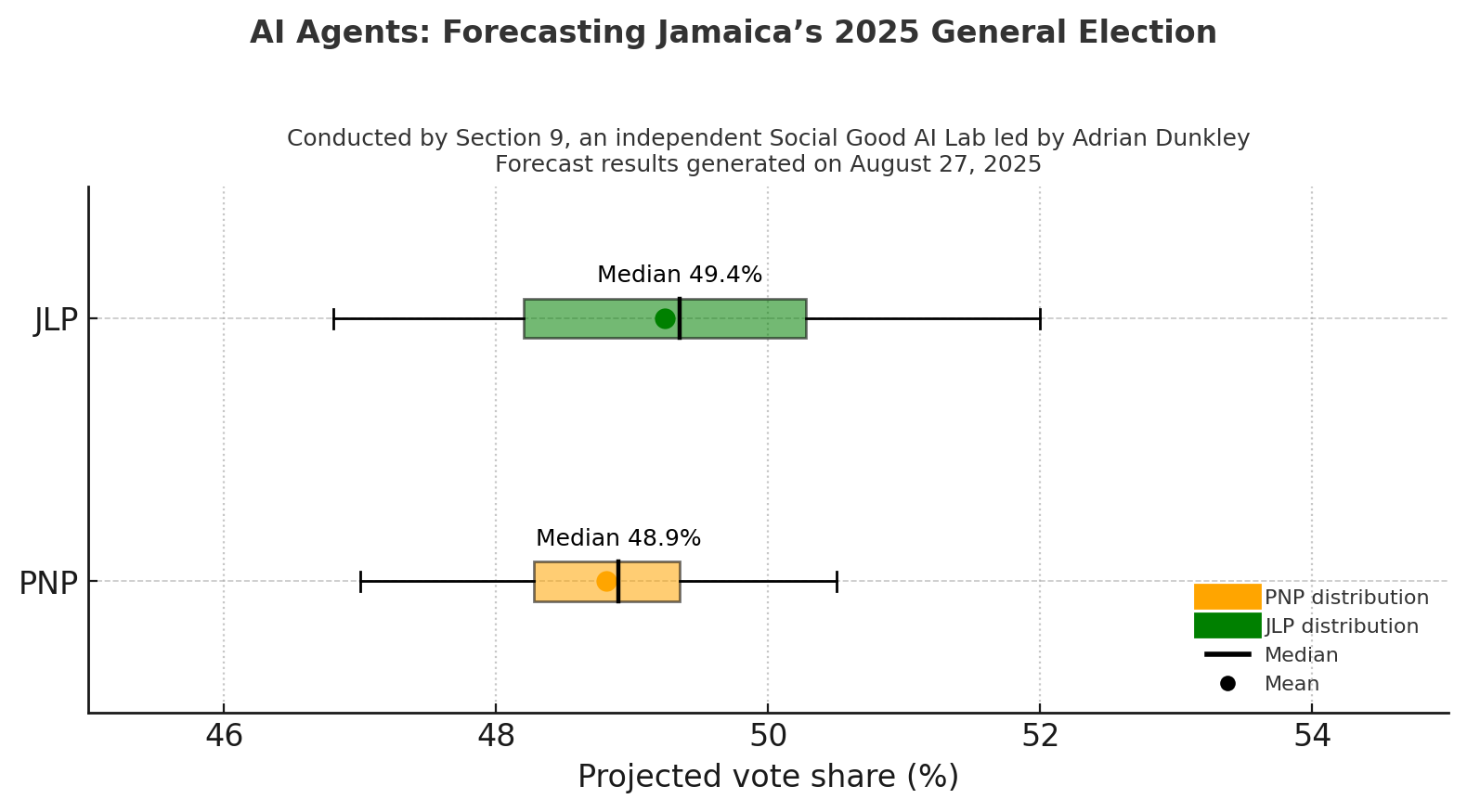
Boxplot - Vote Share Prediction from The Council of AI Agents
Council Voting Outcome
JLP: 5 votes (56% excluding undecided)
PNP: 4 votes (44% excluding undecided)
Undecided: 1 vote
Council Median Projection
Popular Vote: JLP 49.6 percent, PNP 49.4 percent, Others 1.0 percent
Seat Range: JLP 31 to 34, PNP 29 to 32
Ensemble Margin of Error: ±1.8 percentage points for JLP, ±1.5 percentage points for PNP
Distribution Across Agents
JLP forecasts: 49 to 53 percent, with 31 to 38 seats
PNP forecasts: 47 to 50.5 percent, with 29 to 33 seats
One agent declined to allocate a final outcome
The spread shows the contest is inside a statistical deadlock. Even modest swings in turnout could flip five or more seats. The Council of AI Agents forecasted that JLP would capture 34 seats, to PNP’s 29 seats, producing a razor-thin result.
Debate Highlights
Stability versus change: Pro JLP agents stressed continuity and stability, while pro PNP agents emphasized governance fatigue and cost of living hardships.
Mobilization and apathy: All agents highlighted the decisive role of voter turnout. Low turnout favors incumbents with stronger machinery, while surges in youth or protest voting favor challengers.
Legitimacy: Several agents warned that even if JLP retained power, it would be without a broad mandate, leaving governance fragile.
Limitations
Although constituency-level arithmetic and voter sentiment gaps were factored into the methodology, they remain limiting variables.
Forecasting uncertainty: Currently, AI agents cannot capture late breaking events or last minute shifts in perception in the Caribbean.
Data dependence: Web sources provide reach, but not all community-level nuances are captured digitally.
Interpretive bias: Different reasoning styles produce variance. Some agents focused on structure, others on legitimacy, others on public mood.
Turnout prediction: Participation remains the single greatest source of error, with a five percent turnout swing capable of overturning the seat balance.
Next Steps
Develop seat-by-seat simulations incorporating demographic overlays and historical margins.
Expand real-time voter sentiment monitoring in ways that are anonymized and ethical, especially among disengaged and younger voters.
Convene the Council in iterative sessions as election day approaches to track changing momentum.
Extend the methodology to other Caribbean and developing country elections where polling data is sparse.
Social Benefit and Value
This Council demonstrates that AI can expand democratic analysis in smaller states.
It provides transparency, showing a range of outcomes rather than a single deterministic forecast.
It incorporates a plurality of perspectives, from statistical modelling to social legitimacy.
It bridges gaps in polling, especially where surveys are inconsistent or incomplete.
It enhances civic literacy, helping the public understand why elections are close rather than simply speculating on winners.
Conclusion
The Council did not speak with one voice. Five agents predicted a razor-thin JLP victory, four favoured a PNP upset, and one abstained. The Council’s conclusion was cautious. The central projection pointed to a very narrow advantage for the Jamaica Labour Party (JLP), but the deliberation revealed deep divisions and uncertainty. The ensemble median projects JLP at 49.6 percent and PNP at 49.4 percent, with an error band of under two points. The Council of AI Agents forecasted that JLP would capture 34 seats, to PNP’s 29 seats, producing a razor-thin result.
The strongest shared conclusion was not a forecast but a warning: mobilization in the final week will decide the government of Jamaica.
📌 This study was produced by Section 9, an independent AI research lab. The Council of AI Agents is an experimental methodology designed to synthesize insights from multiple advanced AI systems in order to improve political forecasting, civic education, and democratic literacy. Findings published on August 27 2025.