CARICOM Skills Passport: Turning Regional Potential into Regional Power, with A.I
The Caribbean is full of talent. Across our islands are professionals, artisans, and innovators who want the freedom to work, learn, and contribute wherever their skills are needed. Yet this potential is often trapped by slow systems, unverified records, and administrative barriers. The CARICOM Skills Passport, supported by Blockchain and Artificial Intelligence, offers the chance to unlock that potential.
It is not only a technical project. It is a social and economic transformation tool. If implemented strategically, it could unify labor markets, reduce inefficiencies, and build a region that values skill over location. If handled poorly, it could become another well-intentioned system that never reaches the people it was built for.
The difference will depend on one thing: how well we combine trust, technology, and transparency.
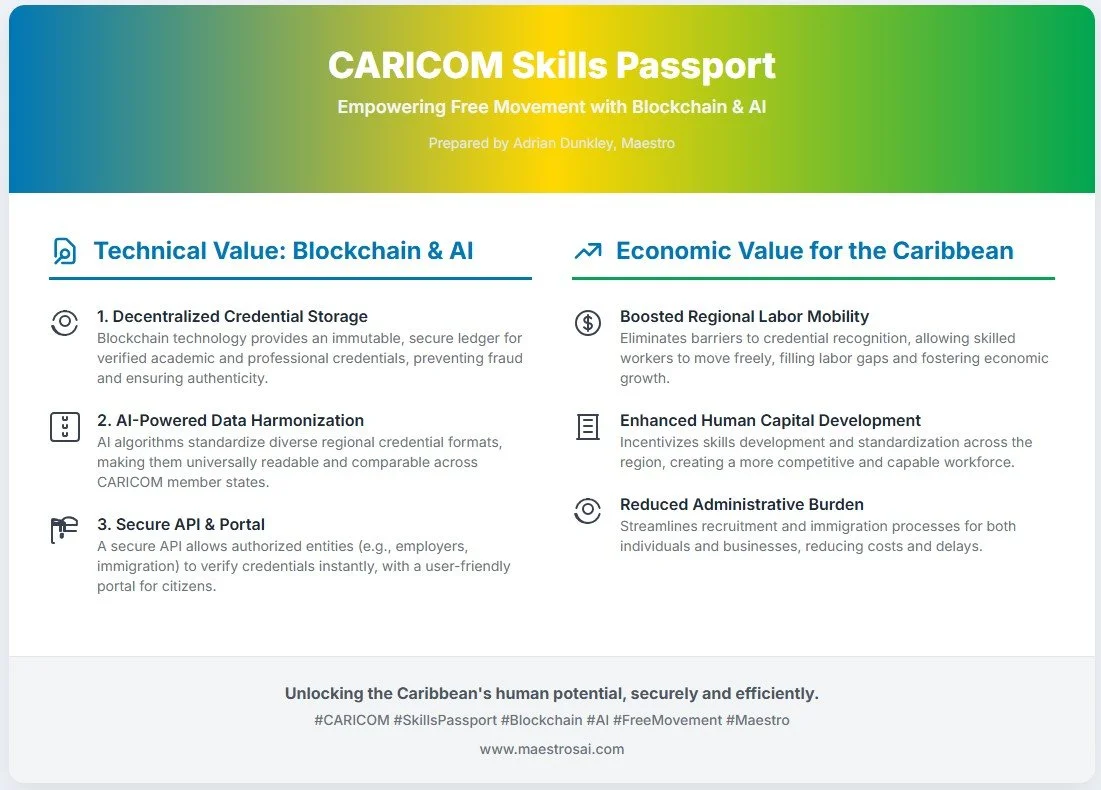
CARICOM Skills Passport empowering Free Movement with Blockchain & A.I
The Opportunity: Building a Connected Regional Workforce
The CARICOM Skills Passport provides a digital platform where citizens can store and share verified academic and professional credentials. Using Blockchain, each credential becomes tamper-proof, traceable, and secure. Fraud and duplication can be eliminated, creating confidence among employers, governments, and citizens.
Artificial Intelligence brings a second level of value. It allows the system to harmonize data across countries and institutions, interpreting different credential formats and aligning them under one framework. A diploma from Jamaica should mean the same thing as one from Barbados. AI can make that possible in real time.
When used together, Blockchain and AI create a foundation for genuine free movement across the Caribbean. Skilled people can fill labor gaps without long delays. Businesses can access trusted talent faster. Governments can analyze skills data to guide investment and workforce planning.
The Challenge: Trust Is Stronger Than Technology
Technology cannot solve distrust. The region must create a verification structure that ensures every credential in the system can be trusted by every member state. This requires a regional body with the authority to standardize processes, accredit institutions, and investigate anomalies.
Without this, the system may work technically but fail operationally. Employers might still rely on paper copies, and immigration departments might avoid digital checks.
Mitigation: Create a CARICOM Credential Verification Authority (CVA). This body would oversee the network of institutions allowed to issue and verify credentials. It would also manage dispute resolution and ensure uniform standards for data accuracy and authenticity.
The Intelligence Layer: Using AI for Regional Foresight
AI should not be used only for matching records. It should also help shape the region’s understanding of where skills exist and where they are needed. Predictive models could show future shortages in renewable energy technicians, financial analysts, or cybersecurity specialists. Universities could adjust programs to meet demand. Governments could direct funding toward priority areas.
However, AI can also amplify inequality if its data sources are unbalanced. If smaller states contribute less data, they risk being underrepresented in regional forecasts.
Mitigation: Require open, transparent AI models that can be reviewed and audited by all member states. Establish a shared data governance policy that ensures fair participation and visibility for every country, regardless of size.
The Gateway: A Secure Regional Portal for Citizens
Every citizen should have a single digital point of access to view and share their verified credentials. Employers and immigration agencies should be able to confirm authenticity instantly through secure APIs. The portal must be intuitive, multilingual, and accessible on mobile devices.
If it is complex, slow, or poorly localized, adoption will suffer. The region has seen many good ideas fail because they were not user-friendly.
Mitigation: Design the portal using real citizen feedback. Test it in smaller states before full rollout. Include offline verification tools for rural areas, such as QR codes or mobile tokens.
The Integration: Linking Digital Identity, Education, and Employment
The Skills Passport will reach its full potential when it connects to a regional digital identity system. This integration will allow credentials to update automatically as citizens complete new training or certifications. It will also make regional mobility smoother, as the same identity can be used to apply for jobs, renew licenses, or register businesses.
Privacy concerns are real. Citizens must know that their personal data will not be shared or sold without consent.
Mitigation: Embed consent-based data sharing into the design from the start. Citizens should have clear control over what is shared, with whom, and for what reason. Governments must publish transparency reports that show how data is used.
The Economic Link: Turning Data into Opportunity
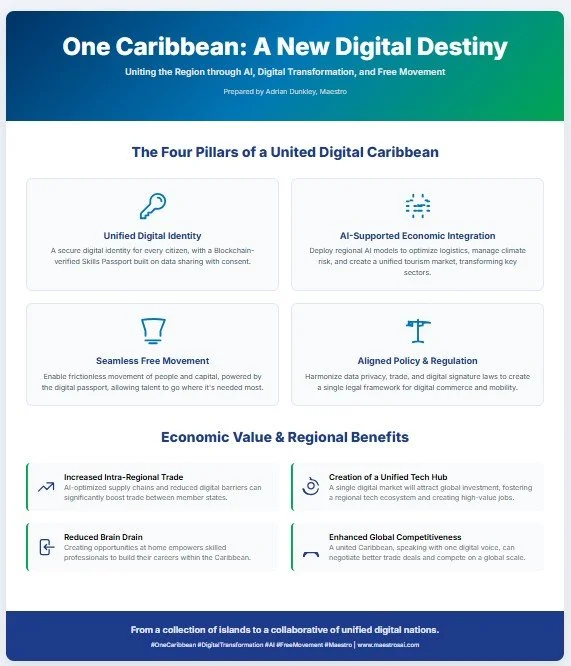
Uniting the Caribbean through A.I
Verification is the first step. The real power comes when verified credentials connect directly to jobs, training, and regional programs. CARICOM should create a digital marketplace where verified talent meets verified demand. This could become the central hub for regional employment and professional mobility.
AI-powered analytics can highlight gaps between available talent and labor market needs. That information can guide both policy and private-sector hiring.
Mitigation: Build a CARICOM Skills Exchange Platform that integrates job boards, scholarships, and regional contracts. Offer incentives for companies that hire or train using the platform.
The Risks: Cybersecurity, Inequality, and Political Fragmentation
A system that holds millions of personal and professional records becomes an attractive target for cyberattacks. One breach could destroy confidence in the entire initiative. Strict cybersecurity standards, independent audits, and continuous penetration testing must be mandatory.
Another risk is inequality. Larger economies with more advanced digital systems could dominate the network, while smaller states lag behind. Political transitions could also disrupt consistency if new administrations deprioritize regional collaboration.
Mitigation: Adopt a federated model where each country maintains its own node in the network while following common security and verification protocols. This balances sovereignty with shared governance.
The Long View: From Islands to an Intelligent Region
The CARICOM Skills Passport is not just a technology project. It is a foundation for a digital Caribbean. Once established, it can serve as the base for other regional systems in trade, health, and finance. It is a step toward a unified digital identity and a more connected economic space.
If done right, it will do more than verify credentials. It will build confidence, encourage mobility, and help every citizen see the region as one space of opportunity.
If done poorly, it could become a fragmented system that no one trusts, wastes funding, and reinforces old divisions. The difference will come from governance, collaboration, and consistent leadership.
Strategic Recommendations
Establish a CARICOM Credential Verification Authority for oversight and governance.
Implement auditable AI systems for harmonization and workforce analysis.
Build a citizen-centered digital portal with mobile and offline access.
Integrate with regional digital identity frameworks under a consent-based policy.
Create a CARICOM Skills Exchange Platform to connect verified talent with real opportunities.
Apply regional cybersecurity standards and conduct annual independent audits.
Promote inclusion through micro-credentialing for informal and technical workers.
Use a federated governance model to ensure equality among member states.
The Caribbean has the talent, the technology, and the timing. The CARICOM Skills Passport can turn that combination into a new engine of growth. It can transform free movement from an aspiration into a practical reality.
The region’s future will not be decided by who owns the most land or capital, but by who manages talent best. The Skills Passport can make that management intelligent, fair, and future-proof.
When every citizen can verify their worth, mobility becomes merit-based, and the Caribbean begins to function as one connected space of opportunity.
That is the promise of a truly digital Caribbean.
The Author
Adrian Dunkley is an AI Expert, Scientist, and Entrepreneur recognized as one of the Caribbean’s leading voices in Artificial Intelligence. He is the Founder and CEO of StarApple AI, the region’s first AI company, focused on developing intelligent systems that improve lives and businesses across finance, tourism, education, and national security.
Adrian is an award-winning innovator, known for integrating AI with finance, edtech behavioural science and economics to create practical, human-centered solutions. He has led more than 150 AI projects, trained over 1,000 professionals in AI and data science, and has represented the Caribbean internationally in discussions on AI ethics, readiness, and inclusion.
His work continues to focus on building a smarter, more connected Caribbean, where technology unlocks the full potential of human talent.
Questions and Answers
What is CARICOM?
CARICOM, the Caribbean Community, is a regional organization made up of twenty countries working together to promote economic integration, cooperation, and development across the Caribbean. It was established to create a single economic space where goods, services, capital, and people can move freely among member states. CARICOM also coordinates policy across trade, education, technology, and foreign affairs, aiming to strengthen the region’s collective voice on the global stage.
What is the CARICOM Skills Passport?
The CARICOM Skills Passport is a digital credential system designed to verify and recognize the qualifications and professional experience of Caribbean citizens. It allows skilled workers to move, study, or work freely across member states without repeatedly revalidating their credentials.