Agentic AI and the Future of Storm Preparedness

Hurricane Melissa Category 5 Hurricane approaching Jamaica, October 27 2025
Understanding the Human Side of Storms
When a storm approaches, data tells us how strong it is and where it is heading. What it does not tell us is how people will respond. Some communities prepare days in advance. Others wait until the final hour. Understanding this difference is key to saving lives and minimising damage.
In the Caribbean, artificial intelligence is helping bridge that gap. AI researchers across the region, led by Adrian Dunkley, have developed a new agentic AI system to measure and interpret public threat perception. This initiative will be tested during Tropical Storm Melissa, tracking how people across the Caribbean and Latin America perceive and respond to the threat in real time.
The goal is simple yet powerful: to give governments, private organisations, and relief agencies the ability to understand not only where the storm is going, but how prepared their people are.
What Agentic AI Means for Disaster Preparedness
Agentic AI refers to intelligent systems that can think, act, and adapt independently. Unlike traditional machine learning, which waits for instructions, agentic AI can gather information, reason about it, and take context-aware action.
In the context of storms, an agentic system can monitor public digital activity such as search patterns and online conversations to identify where concern is rising or where awareness is low. It does not replace meteorologists or emergency managers—it amplifies their reach by providing behavioural intelligence alongside weather data.
This new model builds on years of regional research into AI for crisis management. By combining data from weather forecasts, online behaviour, and historical disaster response, the system provides real-time insights into how communities feel, think, and act before a storm hits.
The Hurricane Threat Perception Score: Insights from Jamaica
The Hurricane Threat Perception Score created by Adrian Dunkley and Maestro provides a powerful example of what digital behaviour can reveal.
The data ranks Jamaican parishes by their level of online concern about hurricanes, based on the proportion of storm-related searches compared to total searches in each parish. Westmoreland scored the highest at 100, followed by Saint Mary and Saint Ann, both at 86. Meanwhile, Saint Elizabeth and Saint Thomas recorded lower scores, suggesting lower online engagement or delayed awareness.
This insight matters. If a storm threatens low-awareness regions, it means emergency communication needs to shift quickly from national messaging to hyperlocal campaigns. Agentic AI can automate this shift by analysing patterns in real time and alerting agencies when public concern does not match actual risk.
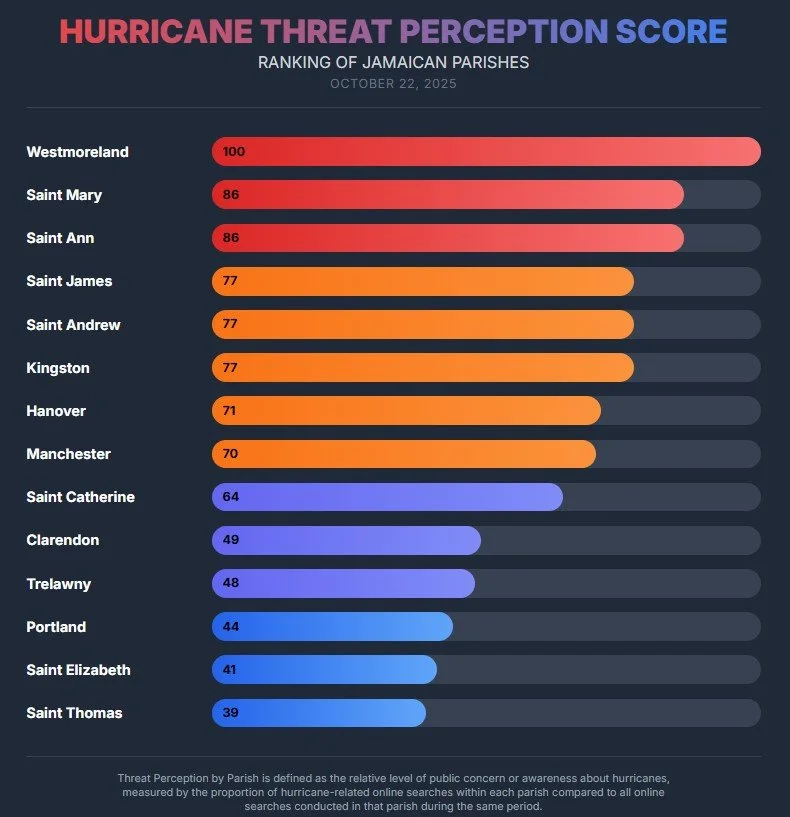
Agentic AI Hurricane Threat Perception Score - Jamaica (October 22 2025)
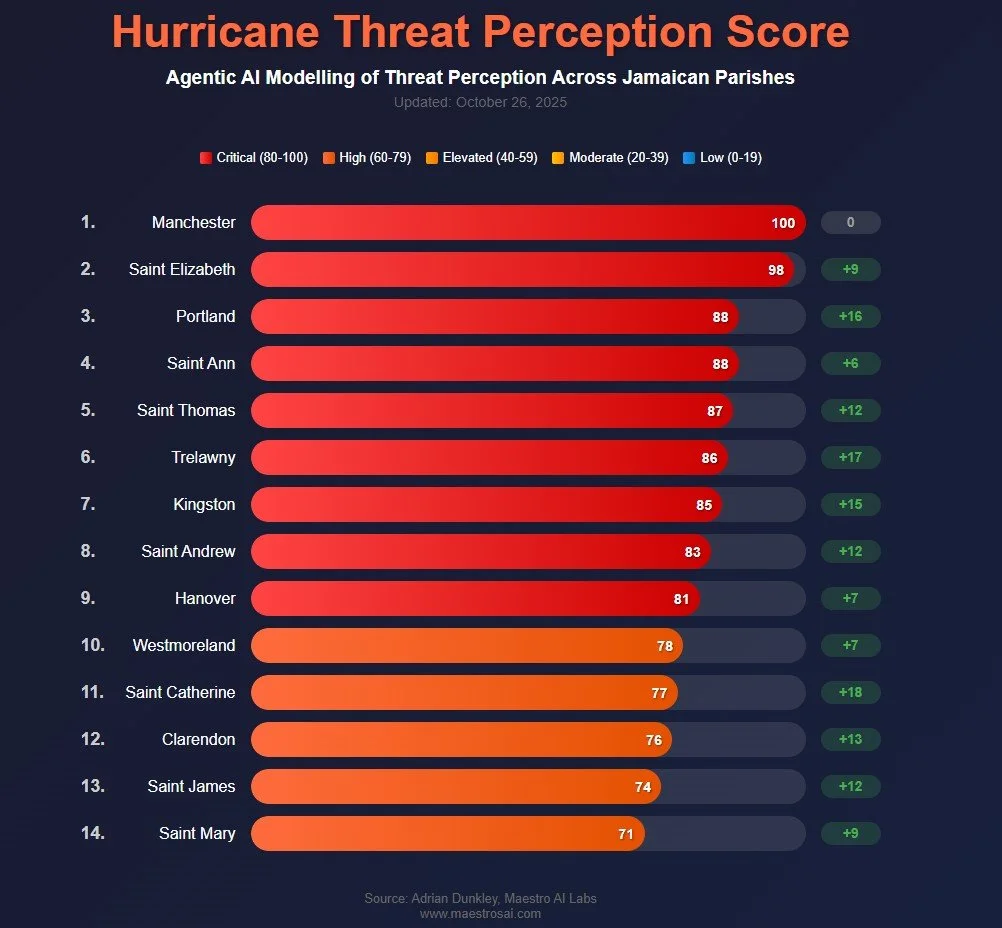
Agentic AI Hurricane Threat Perception Score - Jamaica (October 26 2025)
How the Agentic System Works
The agentic system built by Caribbean AI researchers is designed to process multiple sources of information simultaneously. It analyses search queries, social media conversations, government advisories, and even news coverage to form a complete view of public sentiment and action.
When the system detects a spike in hurricane-related discussions in one area, it can identify whether the conversation reflects curiosity, fear, or misinformation. If a parish or province shows little engagement despite being in the path of the storm, the AI notifies communication teams to increase outreach.
The model will incorporate memory. Each storm becomes a new dataset, improving the AI’s ability to interpret language, tone, and urgency across regions and dialects. From Jamaica to Trinidad, Guyana to Panama, it learns how communities react differently—and why.
Agentic AI Modelling of Threat Perception Across Jamaican Parishes
The Agentic AI Threat Perception System was designed as a hybrid cognitive architecture that integrates the reasoning capabilities of GPT-4.1 and Gemini 2.5 within an agentic control framework. The goal was to create an adaptive, data-driven model capable of inferring public threat perception at the parish level across Jamaica during Hurricane Melissa.
1. System Architecture
The system operates through a three-tier agentic network:
Semantic Analysis Agent (GPT-4.1): Extracted narratives, tone, and urgency indicators from official bulletins, news releases, and public statements. It identified qualitative markers such as “panic,” “evacuation,” or “severe flooding.”
Signal Fusion Agent (Gemini 2.5): Processed quantitative evidence from datasets including relief distribution logs, infrastructure operations, and digital-activity metrics. Gemini 2.5’s multimodal capacity allowed integration of tabular, textual, and trend data from search and social platforms.
Controller Agent: Managed information flow and model hand-offs, applying reinforcement signals to maintain consistency between human sentiment data and objective preparedness metrics.
This configuration created a feedback loop in which the two foundational models operated autonomously but synchronised through iterative reasoning cycles.
2. Data Pipeline and Feature Engineering
The dataset combined official reports, news archives, and digital signals:
Institutional sources: Meteorological Service of Jamaica, National Works Agency, ODPEM, and parish disaster committees.
Digital sources: Keyword frequencies, geotagged social-media posts, and search-engine interest scores for storm-related terms.
Each parish record was transformed into a structured observation defined by four principal variables:
Relief Prepositioning Intensity (RPI) – timeliness and scale of resource deployment.
Infrastructure Preparedness Priority (IPP) – level of operational focus on drains, shelters, and roads.
Local Leadership Urgency (LLU) – emphasis and frequency of warnings or advisories.
Public Distress Signalling (PDS) – online sentiment, health alerts, and social-media discussions indicative of anxiety or concern.
To handle data sparsity, particularly uneven digital engagement across parishes, the system employed a Bayesian smoothing prior and adaptive weighting. Regions with limited digital data were regularised toward the national mean, while areas with abundant signals retained higher variance, preserving authentic spatial differentiation.
3. Scoring Algorithm
Each variable was assigned an ordinal weight based on historical hurricane response relevance. Weighted sums were normalised and min–max scaled to a unified Threat Perception Index (TPI):

Where TiT_iTi is the final threat perception score for parish i, and WiW_iWi represents the aggregate weighted signal.
A high TPI indicates a stronger perceived threat, inferred from both behavioural (social/digital) and institutional (operational) indicators.
4. Cognitive Loop and Validation
The agentic loop consisted of:
Assimilation: GPT-4.1 performed semantic extraction of public and official communications.
Quantification: Gemini 2.5 computed numerical equivalents and signal densities from search and social-media streams.
Calibration: The Controller Agent re-weighted each factor using historical baselines from previous storms (Ivan, Beryl, Gilbert).
Feedback: Discrepancies between qualitative fear indicators and quantitative response intensity triggered dynamic coefficient updates until convergence.
This iterative mechanism allowed the system to self-adjust for sparsity, regional bias, and overlapping signals.
5. Output and Application
The final deliverable, a parish-level Threat Perception Index (0–100), visualises differential perception of danger across Jamaica. Policymakers and emergency planners can now prioritise communication, evacuation planning, and mental-health outreach where perceived risk is highest, not solely where physical exposure is greatest.
Two Key Capabilities of the System
Real-Time Awareness Mapping
The agent continuously measures changes in public interest and sentiment about the storm. It creates a visual map that shows where awareness is high and where it is falling behind.Adaptive Response Recommendations
Based on behavioural patterns, the AI recommends where to send alerts, how to adjust communication tone, and when to escalate readiness operations.
These two capabilities transform how regional agencies understand and manage preparedness. Instead of relying only on forecasts, they gain insight into the emotional and behavioural patterns that define real-world response.
Benefits for the Caribbean and Latin America
The impact of agentic AI extends beyond weather forecasting. It represents a shift toward proactive, data-driven decision-making. Governments and organisations across the region can use the system in multiple ways.
For governments and disaster agencies, this technology provides early insight into community readiness. Instead of treating preparedness as uniform, officials can prioritise parishes or provinces where awareness lags behind. For insurance companies, it refines risk models by combining hazard data with public sentiment trends. It helps them anticipate where claims or damage reports might concentrate.
Utility and telecom companies can use these insights to pre-position repair teams and prepare customer service channels ahead of expected surges. For media outlets, the data highlights where communication gaps exist, allowing them to deliver targeted, fact-based updates and counter misinformation.
Even hospitals and health networks can benefit. By tracking how search patterns for medicines, supplies, and emergency care change during a storm, healthcare planners can anticipate demand and prepare staff accordingly.
A Regional Framework for AI-Driven Resilience
Adrian Dunkley’s leadership in developing the agentic storm perception model represents an important step for Caribbean AI research. The system will first be tested in Jamaica, with plans to expand across the region.
By integrating linguistic and cultural variations, the AI can adapt to both English-speaking and Spanish-speaking contexts. It understands that people in Kingston express urgency differently from those in Port of Spain or Georgetown. This linguistic adaptability is what makes the model particularly suited for Caribbean and Latin American use.
Moreover, the project is built on ethical data principles. The system analyses public and aggregated data only, ensuring privacy while still providing valuable insights for policymakers and humanitarian responders.
Linking Perception with Preparedness
The hurricane threat perception data from Jamaica illustrates an essential point: awareness is uneven. Some parishes demonstrate a heightened sense of risk, while others appear less concerned.
Agentic AI bridges that gap. When combined with weather models, it creates a feedback loop between forecasting and public behaviour. Decision makers can see both the physical and psychological maps of a storm.
For instance, if Tropical Storm Melissa is expected to impact western Jamaica, where threat perception is already high, communication efforts can focus on readiness and logistics. If forecasts shift toward Saint Thomas, where perception is low, campaigns can pivot to raise awareness and counter complacency.
This ability to anticipate not just weather but also human response changes how the Caribbean prepares for storms. It allows governments to act early, businesses to plan efficiently, and communities to stay informed.
Broader Applications Beyond Storms
While the first pilot targets Tropical Storm Melissa, the potential uses for this agentic framework are wide. It can be adapted for other crises such as droughts, wildfires, floods, and public health emergencies. Any situation that requires understanding human behaviour at scale can benefit from this technology.
In Latin America, similar systems could help measure public concern during heatwaves or epidemics. For the Caribbean tourism sector, it could assess traveller sentiment during high-risk weather periods, guiding communication that preserves trust and reputation.
In time, this framework may become a standard part of national disaster preparedness strategies, integrating social data with satellite observations, economic indicators, and communication systems.
The Future of AI-Driven Resilience
The development of this agentic AI system marks a new era for the Caribbean’s approach to climate resilience. It shifts disaster response from reactive to anticipatory. It adds a human dimension to data science, acknowledging that preparedness depends as much on awareness as on forecasts.
This initiative shows that the Caribbean is not merely adopting global technology but shaping it to reflect regional realities. By combining science, data, and human psychology, the region can lead a global movement in AI for disaster intelligence.
The question for the next decade will not only be “Where is the storm going?” but also “Are our people ready for it?” Thanks to agentic AI, we may soon have both answers.
Frequently Asked Questions (FAQ)
What is a Hurricane?
A hurricane is a powerful tropical cyclone that forms over warm ocean waters. It is characterised by strong rotating winds, heavy rainfall, storm surges, and low atmospheric pressure. Hurricanes are classified from Category 1 to 5 on the Saffir–Simpson scale, based on sustained wind speed. In the Caribbean, hurricanes often develop in the Atlantic and move westward, gaining energy from warm sea surfaces before making landfall.
What is a Hurricane Melissa?
Hurricane Melissa is a major tropical cyclone that formed in October 2025 in the central Atlantic and strengthened rapidly as it approached the Caribbean. By October 27, it reached Category 5 intensity, with sustained winds exceeding 145 mph and heavy rainfall projected to reach 30 inches in some areas.
Jamaica was placed under full hurricane warning as the storm moved westward, prompting mandatory evacuations in several flood-prone communities, including Port Royal (Kingston), Old Harbour Bay (St Catherine), and Portland Cottage (Clarendon).
The storm’s structure produced severe wind fields, storm surges of up to 13 feet, and widespread inland flooding. Emergency agencies such as the Meteorological Service of Jamaica, ODPEM, and the National Works Agency coordinated disaster response, while international agencies tracked potential impacts on infrastructure, agriculture, and public health.
What is Agentic AI
Agentic AI refers to artificial intelligence systems that can operate with a degree of independence and reasoning. Unlike traditional AI, which reacts to direct inputs or preprogrammed instructions, agentic AI can observe its environment, make contextual decisions, and act on behalf of its user or organisation. It is designed to think critically, plan tasks, and take initiative within defined goals.
In disaster management, this means an agentic AI system can monitor real time data such as search trends, social media activity, or weather updates, identify risks or information gaps, and recommend or even trigger appropriate responses without waiting for human instruction.
What are AI Agents
AI Agents are the individual components or actors within an agentic AI system. Each agent has a specific role or expertise such as data collection, language analysis, or decision support. They communicate with one another to solve problems collaboratively.
For example, in the context of Tropical Storm Melissa:
One agent may collect and analyse search trends by country or parish.
Another agent interprets social sentiment to understand fear or confidence levels.
A third agent might compile the information into a daily briefing or alert for disaster management teams.
Together, these agents function like a digital team of analysts working continuously.
How Does Agentic AI Differ from Traditional AI Systems
Traditional AI systems perform tasks based on fixed models or scripts. They rely heavily on predefined rules or historical datasets. Agentic AI goes further. It can learn continuously, reason about uncertainty, and perform tasks that require flexible judgement.
In simpler terms, a traditional AI might detect that storm related searches have increased in Westmoreland. An agentic AI would interpret why that spike happened, compare it to weather alerts, estimate how fast concern is spreading, and recommend when to issue public updates or deploy communication teams.
How Can Agentic AI Improve Disaster Preparedness
Agentic AI enhances disaster readiness by combining weather data with behavioural analytics. It helps identify how different communities perceive risk and which populations need additional support or information.
By tracking patterns of concern, misinformation, and preparedness behaviour, AI agents can alert national agencies to intervene early before a storm becomes a crisis. This proactive approach helps reduce panic, improve coordination, and ensure that resources reach the right people at the right time.
Is Agentic AI Safe and Ethical to Use
Yes. The system developed by Caribbean AI researchers follows strict data protection standards. It analyses aggregated and public data only, without identifying individuals. All results are used for community level insights, not personal tracking.
Ethical safeguards ensure transparency, explainability, and fairness. Every automated action such as issuing a risk alert or recommendation includes an audit trail showing what data and logic informed the decision.
Who is Leading This Work in the Caribbean
The initiative is led by AI expert Adrian Dunkley and a team of Caribbean AI researchers. Their goal is to create locally relevant systems that combine scientific modelling with cultural understanding. The first pilot, focused on Tropical Storm Melissa, will measure public threat perception across Jamaica and neighbouring countries, setting a foundation for region wide resilience.
Can Agentic AI Be Used Beyond Storms
Absolutely. While initially designed for hurricanes and tropical storms, agentic AI can be adapted for other crises such as droughts, earthquakes, pandemics, and even social or economic disruptions. The same behavioural analysis principles apply, tracking how populations react to risk and designing interventions that improve safety, awareness, and confidence.
How can AI help manage hurricanes?
AI supports meteorological forecasting, supply-chain optimisation, and behavioural analysis. In this project, Agentic AI assessed how Jamaicans perceived Hurricane Melissa across parishes, combining social data, official reports, and environmental indicators to help decision-makers focus on regions where people felt most vulnerable.
How Does This System Benefit Latin America and the Caribbean Specifically
The Caribbean and Latin America share challenges such as high disaster exposure, limited resources, and diverse languages. Agentic AI helps overcome these barriers by offering regionally tuned intelligence. It interprets cultural nuances, detects multilingual signals, and delivers recommendations tailored to each local context.
This makes it ideal for small island states, where traditional global systems often overlook micro-level differences in population behaviour.